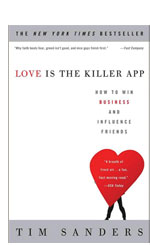
 On Valentine’s Day this year, Chris Brogan published a blog post called Happy Birthday to Love. I was intrigued and clicked on the article (see the benefits of a good headline?!). It was essentially a plug for Tim Sanders’ book Love is the Killer App, which was turning ten years old.
Since I value Brogan’s ideas and outlook on life, I decided to give this book a shot (note that I’m usually not easily persuaded to buy things, but if somebody I trust recommends a book, I usually read it).
I finally got around to it this past week. (Yes, I have a large stack of “read me” books on my bedside table.)
I had no idea what to expect. The subtitle of the book reads “How to win business and influence people,” so I figured whatever the contents were, it couldn’t hurt.
Here’s my review of Love is the Killer App organized by chapter:
The Lovecat Way
Sanders opens the book by defining “The Lovecat Way.” He argues that the way to differentiate yourself in business in the 21st century is to be a “lovecat.”
Here is his definition of love business:
The act of intelligently and sensibly sharing your intangibles with your bizpartners.
This means sharing knowledge, fostering networks, and showing compassion.
And bizpartners include “every person in our work life.” That means competitors too!
Sanders also outlines a series of benefits of being a lovecat including building “an outstanding personal brand” and gaining personal satisfaction. (In case you have doubts that being more loving in business is a good thing…)
Knowledge
Like me, Tim Sanders likes to read. He reads all the time to accumulate knowledge. His approach is systematic and purposeful. In this chapter of Love is the Killer App, he outlines his four-step program for making knowledge work for you:
- Aggregation – Figuring out what to read
- Encoding – Engaged reading with note-taking
- Processing – Review books you finished
- Application – Find opportunities to share the knowledge
Too many people internalize their new information, turning it into private wisdom that cooles in their intellectual cellar. ~Tim Sanders
Sanders notes that it’s important to apply the knowledge right away. If you haven’t found an opportunity to share the knowledge from a book within a couple of weeks, perhaps you’re not reading the right stuff. Then you need to tweak your aggregation method.
Network
You’ve heard that it’s all about networking, right? There are all sorts of tips for finding people to add to your network (go to conferences, chamber of commerce events, etc), remember your contacts (exchange business cards, connect on LinkedIn, etc), and maintaining those relationships (have dinner when you’re in your contact’s town, send a note once a month, etc).
However, this is the first book I’ve read that focuses on helping others expand their networks – without expecting anything in return. (Remember, it’s all about being a lovecat.)
I love this concept. I’m always trying to figure out how people in my own network might benefit from each other.
If you find yourself saying “You should meet…” on a frequent basis, you’re half-way there.
The other half comes from turning that “should” into action:
Being active means becoming firmly involved. If I see a potential connection, I may call one of my nodes and vigorously sell him on the opportunity. ~Tim Sanders
Sanders describes three ways to make these connections:
- Person to Person (most effective)
- Phone
Once the connection is fused, make sure to get out of the connection (or “disappear”).
Compassion
The first two pieces of the puzzle (Knowledge & Network) set the stage for Compassion by building trust and respect.
Compassion is not a quality that one typically associates with businesses. Cut-throat, back-stabbing, and other similar terms are more prevalent.
And that’s too bad.
There is really no reason why business and compassion can’t go together. In fact, according to Sanders, compassion is essential for getting ahead in today’s business world.
So what does it mean to be compassionate in business?
It means expressing compassion through eye contact, big smiles, showing interest in others, two-handed hand shakes, and even hugs (as appropriate and allowed). Pretty basic stuff that can make a world of difference.
Just because we’re at work doesn’t mean that we’re not human; sometimes we need someone to touch us, to make us smile, to make us feel better about ourselves. According to the late Mother Teresa, the greatest disease in the West is not tuberculosis or leprosy; it is being unwanted, unloved, uncared for. ~Tim Sanders
When we started Web Gnomes, we agreed on a No Asshole Policy based on the book The No Asshole Rule by Robert Sutton. I believe Sanders takes this concept to the next level. Not only should you not be an asshole; you should be a lovecat.
Showing compassion for your bizpartners is human and makes sense for business and personal satisfaction.
Over to You!
Have you read Love is the Killer App? If so, what did you think about it? Are you a lovecat? If so, what are some things you do to express your love in business? Do you know any lovecats? If so, how do they make you feel?