This week was relatively quiet in the world of Internet marketing. There weren’t any large conferences or huge announcements. But as always, a lot of great posts were published! Here are just a few of our favorite posts from this past week:
Introducing the Structured Data Dashboard
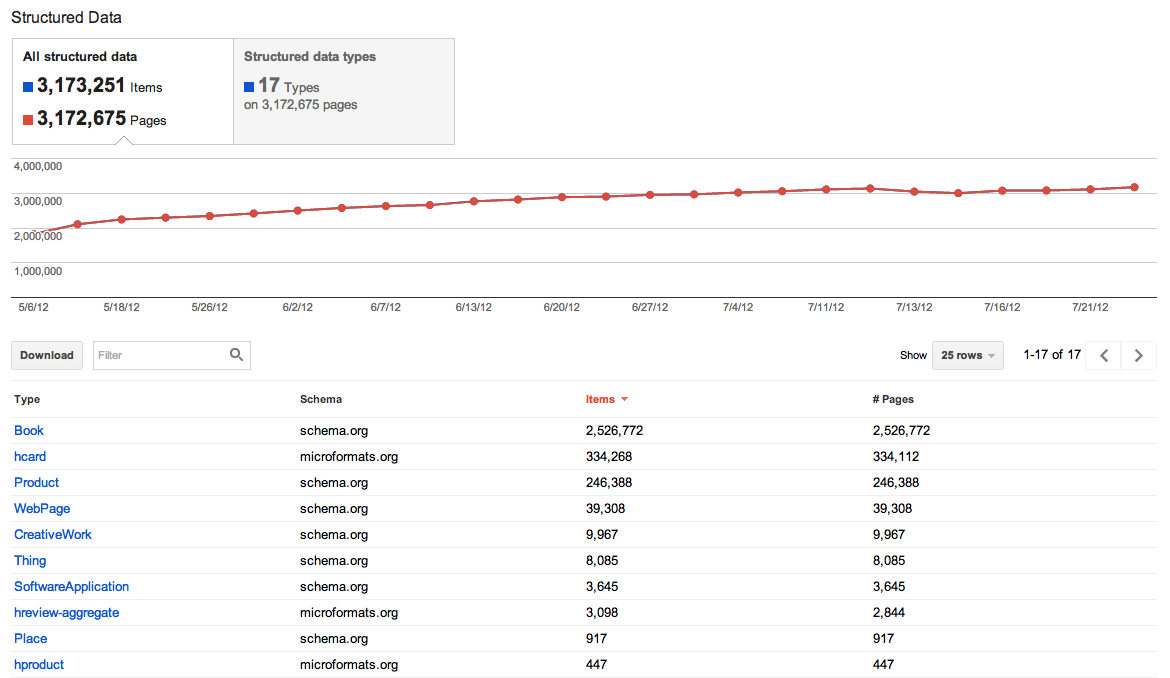
In their continuing effort to be more “transparent,” Google recently introduced a new feature in Webmaster Tools: the Structured Data Dashboard. Fortunately, unlike their previous attempts at transparency (i.e., the latest unnatural links notices), this feature clearly provides value.
In Google, your website’s “structured data” is represented by rich snippets, which are created by annotating important objects on the site. The new Structured Data Dashboard offers three views of this structured data:
Site-level view
The default view (presented by the “Structured Data” link in the Optimization section) shows an overview of the site’s item types and schema formats. Here is an example of a site with more than 2 million Book annotations:
Item type-level view
This view dives a little deeper into a specific item type. It shows specific URLs for items, and it presents a timeline that illustrates how the number of observed items has changed over time (to help you diagnose if items are being properly annotated).
Page-level view
The final view shows all of the item types (and corresponding attributes) for a given page. Here is an example for a Product item type:
URL Naming Best Practices
Sometimes we get caught up in the latest and greatest SEO techniques, and we forget about the fundamentals. This week, Sujan Patel helped remind us about the importance of optimizing your URLs with these naming best practices:
- Keep It Simple – A great URL accurately and succinctly describes its page’s content. Visitors should be able to identify a page’s topic simply by reading the URL.
- Use Static URLs – Static URLs are easier to remember, and they’re easier for search engines to process. If you are unable to avoid dynamic URLs, check Google Webmaster Tools to ensure that Google is handling the parameters correctly.
- Avoid Unnecessary Characters – Leave out extraneous numbers and dates to make sure your URLs are as keyword-focused as possible.
- Use Hyphens to Separate Words – Hyphens are universally accepted by search engines as word delimiters so they are the safest option.
- Avoid Using Subdomains – Don’t dilute your site’s link juice by using subdomains, which are treated as separate sites. Use subfolders to create organization in your site’s URL structure.
- Don’t Use Too Many Keywords – Make your URLs descriptive, but avoid keyword stuffing at all costs!
7 Essential Resources for Chasing Google’s Algorithm
At this year’s MozCon, Dr. Pete openly declared that he’s chasing Google’s algorithm. To help others follow suit, this post provides valuable resources for chasing Google.
You’ll need to read the post for the details, but here are the resources:
- SERP Fluctuations
- Webmaster Forums
- Google Announcements
- Algorithm Surveys
- Correlation Studies
- Search Patents
- Academic Research
Happy chasing…

YouTube Ranking Factors
In this week’s edition of Whiteboard Friday, Jeff McRitchie presents 12 YouTube ranking factors. Videos are an excellent way to break into competitive SERPs, and this video will help you get the most out of YouTube.
Happy Saturday, and enjoy your weekend!